
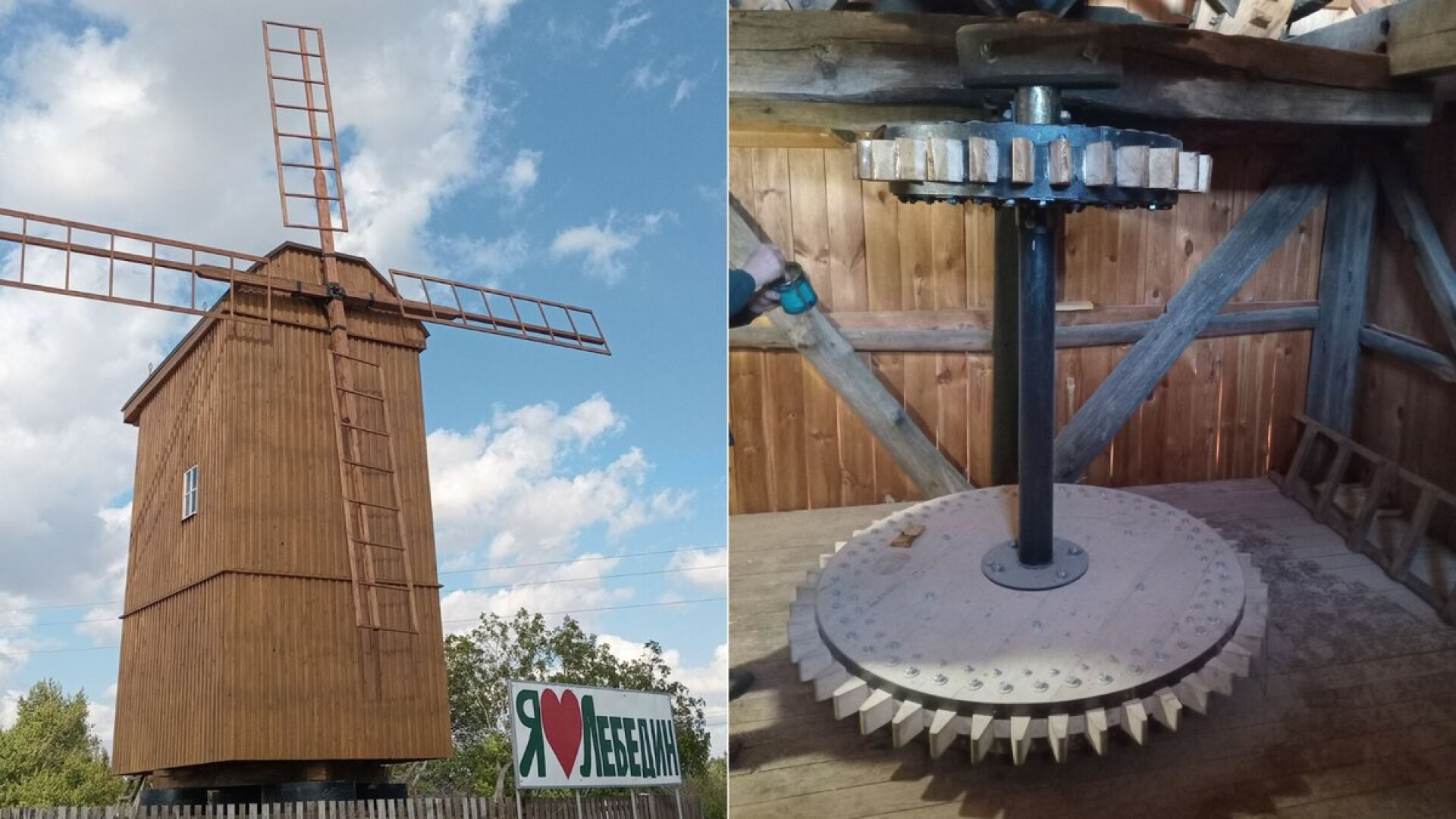
In Lebedyn (Sumy region, Ukraine), a historic windmill more than 100 years old has been restored. It was a nearly destroyed structure — with damaged mechanisms, missing sails, and no ability to operate. In fact, only the main shaft of the mill remained.
The initiator and driving force behind the reconstruction was PJSC “Lebedyn Seed Plant”, and in particular its chief engineer, Oles Demidov. Thanks to the company’s support and the work of a construction team, the project was successfully completed.
Over the course of a year, a team of craftsmen restored the mechanics: they recreated the gears, manufactured new sails, and reassembled the entire drive system.
But the key element was the installation of new millstones, without which the mill cannot perform its main function. The millstones were manufactured at the production facilities of The Miller.
Today, the windmill is working again. And now it is a mechanism capable of grinding grain — just as it did a hundred years ago. The windmill was restored not for industrial use, but as a cultural and historical site. A mill without millstones is a museum. A mill with millstones is a living technology.
The millstones became the element that “brought the entire structure back to life”.
The restoration of historic mills is no longer a series of local initiatives — it is a global movement.
In Europe, there is the RENEWAT project, which unites eight countries around the goal of restoring historic mills as:
cultural heritage sites
tourist attractions
sources of green energy
For example, in the United Kingdom, mill restoration is part of state policy.
The process is coordinated by Historic England and the Society for the Protection of Ancient Buildings. Various programs fund not only restoration works but also training for craftsmen working with millstones, as well as the restoration of watermills as functional mechanisms.
In the United States, there is growing interest in restoring traditional farm windmills. They are being revived by private landowners, museums, and heritage parks.
Today in Ukraine, most historic mill restoration projects are private initiatives, community-driven efforts, or local business projects.
At the same time, in early 2026, the Lviv City Council joined the international RENEWAT (Interreg Europe) project. Within its framework, the community participates in developing approaches to restoring watermills as cultural heritage assets with potential for renewable energy use. The project includes inventorying sites, assessing their condition, and developing models for further restoration and potential financing.
Most historic mills share a common problem: millstones are either lost or no longer usable.
On the market, it is possible to find many “antique” stones, but:
they are often decorative only
they are not suitable for actual milling
or they do not match a specific mill design
That is why finding new millstones made for a specific restoration project is essential.
At The Miller, we manufacture millstones specifically for such tasks — restoring functional mills.
We produce millstones with diameters ranging from 15 cm to 2 meters according to client specifications.
We offer three types of millstone stone, allowing us to match historical requirements and ensure proper mill operation.
Millstones are produced for windmills, watermills, museums, and reconstructed heritage sites.
In other words, for cases where authenticity alone is not enough — functionality matters.
Restoring a mill is not only about history.
Primarily, watermills and windmills are autonomous mechanical grain milling systems that can operate without electricity. In today’s conditions, this becomes especially relevant as an element of local resilience and food security.
Additional value factors include:
If you are restoring a historic windmill, watermill, or museum object, we can manufacture millstones tailored to your project. Contact us — we will provide a solution designed to last for decades.


