
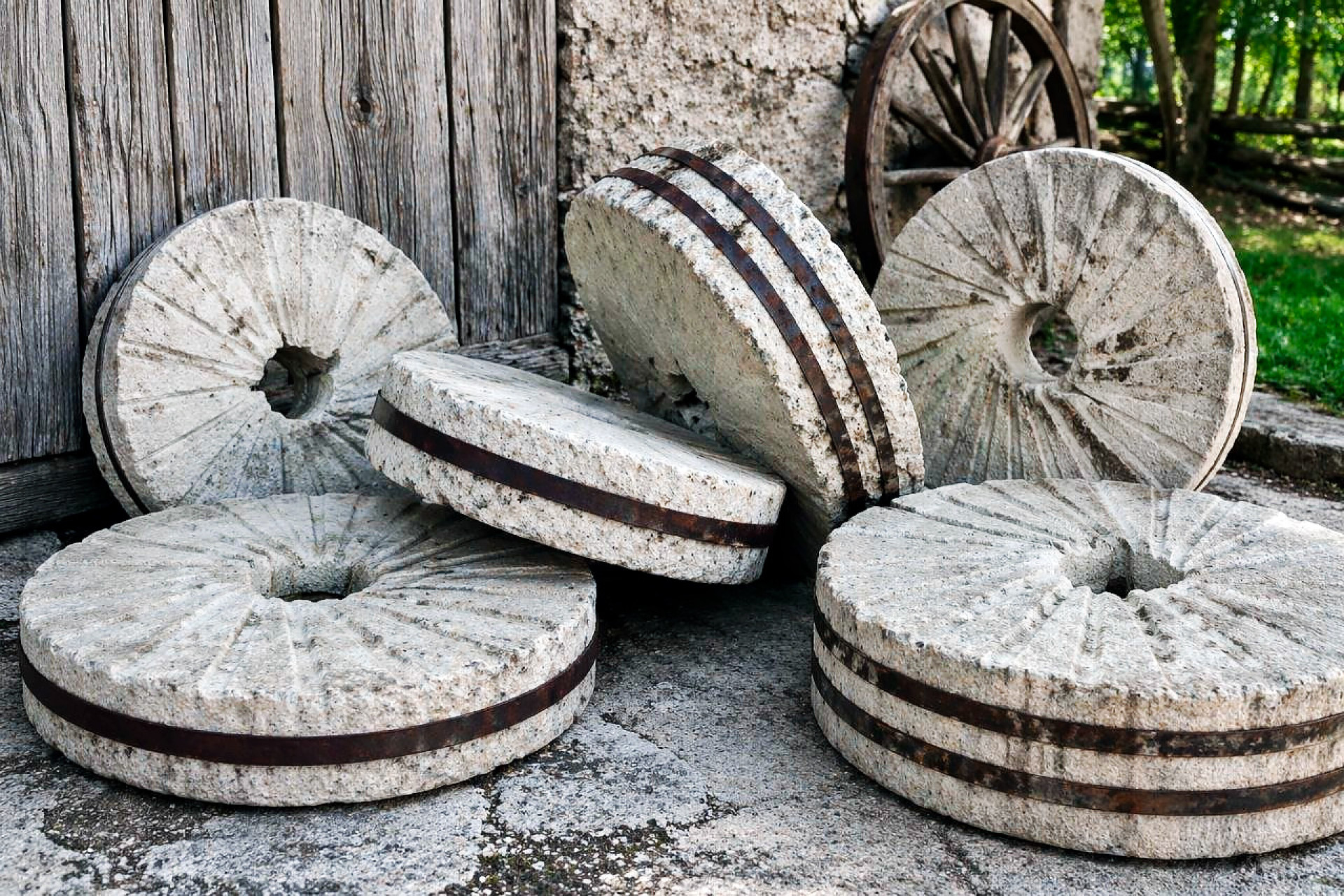
These hoops were not decorative elements. They were a necessary engineering solution widely used in Europe during the 18th–19th centuries, when grain mills became the foundation of the flour milling industry. Their role was directly connected to the physical behavior of the millstone under load.
Milling technology evolved gradually — from manual and animal-powered systems to advanced water-driven complexes capable of continuous operation. A major technological breakthrough came with the introduction of French Burr millstones.
However, quartzite was not available in large monolithic blocks. Instead, millstones had to be assembled from multiple segments — often ranging from 10 to 20 individual pieces. Each segment had to be carefully shaped, positioned, and fixed to form a functional precise surface.
This segmented construction created a structural challenge: without additional reinforcement, the millstone could not maintain its integrity under operational stress.
The primary purpose of metal hoops was to prevent structural failure caused by centrifugal forces and internal pressure. During operation, millstones operate under demanding mechanical conditions:
Millstones rotate at speeds ranging from tens to over one hundred revolutions per minute, generating significant centrifugal forces.
The grain, entering the center and moving outward between the stones, acts like thousands of tiny wedges, creating internal pressure that pushes the stone apart.
Continuous vibration and friction increase the likelihood of microcracks forming over time.
Without reinforcement, these combined effects could lead to cracking or even catastrophic failure of the millstone. In The Young Millwright and Miller’s Guide (1795), widely regarded as the first scientific handbook on milling, Oliver Evans described these mechanical stresses and emphasized the importance of structural reinforcement to ensure safe and reliable operation.
The installation of metal hoops was based on a precise engineering method. The metal ring was heated until it expanded, then placed onto the millstone and rapidly cooled. As the metal contracted, it created a powerful compressive force around the stone.
This method is now recognized as an early example of a pre-stressed structure — a concept widely used in modern engineering. Metal hoops performed several important functions:
They bound individual segments into a unified structure.
They reduced vibration by allowing gaps to be filled with lead or specialized gypsum compounds.
They stabilized the geometry of the millstone.
They extended the service life of the millstones.
Without this technique, segmented millstones would not have been able to operate safely or consistently over long periods.
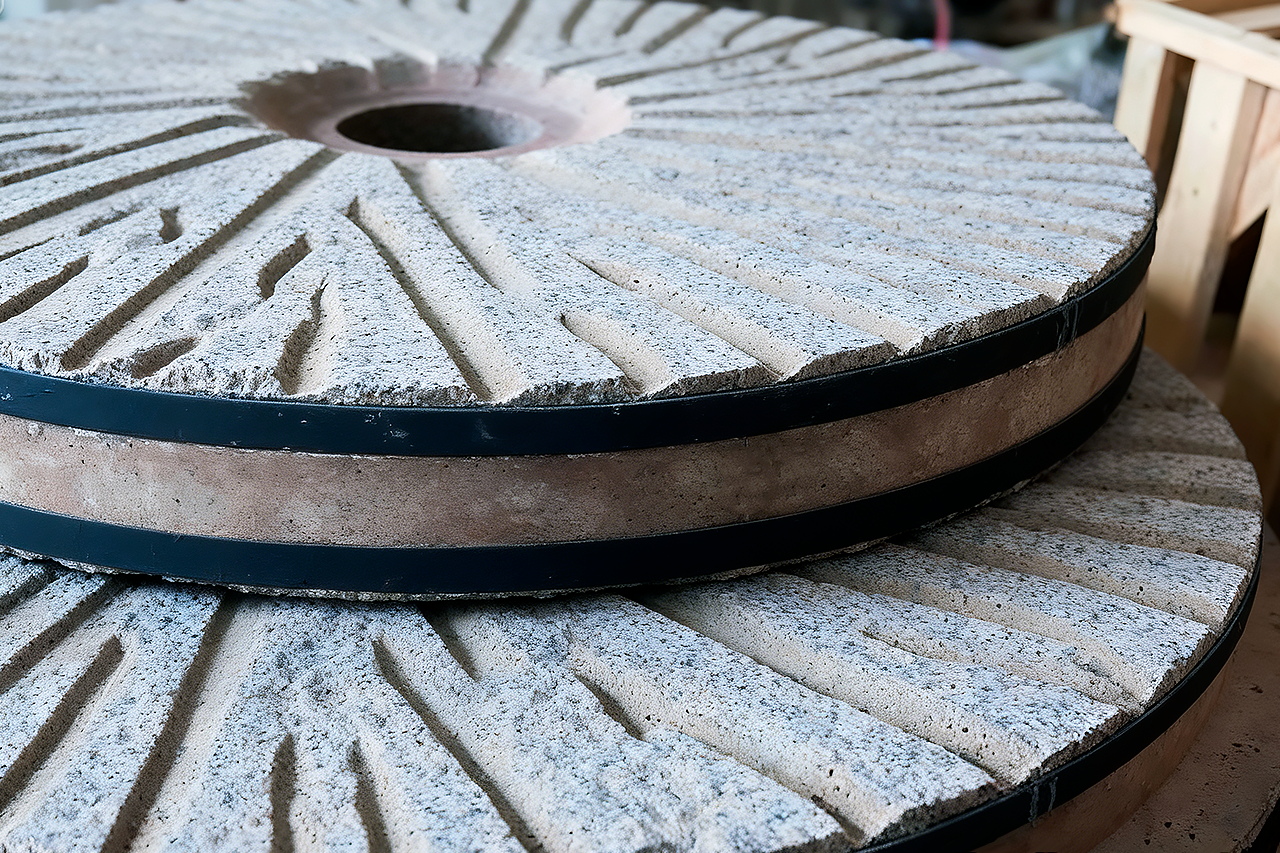
In large industrial mills, it was common to use more than one metal hoop. This was not redundant — it was a calculated engineering decision. ne metal hoop. This was not redundant — it was a calculated engineering decision. Research by The International Molinological Society (TIMS) confirms that mechanical stress within a millstone is not distributed evenly. Both radial and vertical variations in load create zones of higher risk.
Using two or three hoops allowed millers to redistribute stress across the structure, reducing the likelihood of localized failure.
The outer edge (periphery) of the millstone is particularly critical. This is where rotational speed — and therefore mechanical stress — reaches its maximum. Reinforcing this zone significantly improved durability and operational stability.
Multiple hoops also helped compensate for natural variations in material density, imperfections in the stone, and minor structural inconsistencies that developed over time.
Historically, stone milling marked a turning point in flour production. Over time, millers developed practices that allowed them to achieve stable and consistent grinding while preserving the natural value of the grain.
The Miller builds on this principle while applying a fundamentally different structural approach.
Instead of segmented constructions, The Miller uses solid granite millstones — a dense natural material with high structural integrity and low abrasion rate. This approach helps ensure stable and consistent grinding and contributes to long service life.
In this case, there is no technological need for metal hoops. A solid millstone does not require external reinforcement, as its strength is defined by the integrity of the material itself.
At the same time, metal hoops remain an important part of milling heritage. In some The Miller solutions, they are preserved as a design element that reflects traditional engineering and milling heritage rather than a structural necessity.


