
For sourdough bakeries in particular, this is critical. Flour is the foundation of fermentation stability, dough structure, and repeatability of results. Even small variations in flour characteristics can affect the entire production process.
In this context, a stone mill for bakeries becomes a tool of operational resilience rather than just bakery equipment.
Even when bakeries work with high-quality flour from large and reliable millers, flour remains an external input.
This means the business:
does not control the origin of the grain,
cannot fully control flour characteristics,
depends on logistics and supply availability,
operates within market-driven constraints.
In stable conditions, this model may work. But in volatile environments, any disruption in supply directly affects production continuity.
Switching to on-site grain milling using a stone mill changes the operational logic of a bakery.
Instead of depending on ready-made flour, the bakery gains the ability to:
select grain independently,
define flour characteristics for specific recipes (grain types, milling fineness, custom blends),
work with freshly milled flour from its own mill,
adapt production quickly to changing conditions.
This provides direct control over one of the most critical variables in baking.
Competition in the sourdough and artisan bread segment continues to grow. As a result, bakeries are differentiating not only through product quality but also through their production philosophy.
Freshly milled flour allows bakeries to:
increase transparency of production,
build stronger brand trust,
emphasize their craft-based identity.
However, the key value remains operational — the ability to control the process rather than depend on it.
In today’s environment, a stone grain mill functions as a resilience tool for bakeries.
On-site milling enables more flexible production planning, especially during logistics disruptions or periods of market instability.
Bakeries can work with available grains and adjust production parameters quickly (grain types, flour characteristics). This creates stability in crisis scenarios where continuity is essential.
On-site milling also opens a new revenue stream — selling freshly milled flour as a standalone premium product to consumers or other bakeries.
This can provide an additional source of income and help fully utilize production capacity.
However, this direction requires separate packaging, logistics, and positioning strategies, while significantly strengthening overall business resilience.
Recent years have shown that even well-established supply chains can be disrupted. A stone mill does not eliminate all risks, but it significantly reduces dependence on one of the most critical external factors — commercial flour supply chains.
It also enables bakeries to work more closely with local grain producers, supporting a more stable and resilient business model.
Artisan sourdough bakeries rely on precision, stability, and process control. Without control over flour, the system remains vulnerable.
A stone grain mill is not just equipment for milling grain. It is a strategic tool that reduces dependency on external inputs and increases operational resilience.
In an unstable world, this is no longer just a trend — it is a practical strategy for survival and growth.
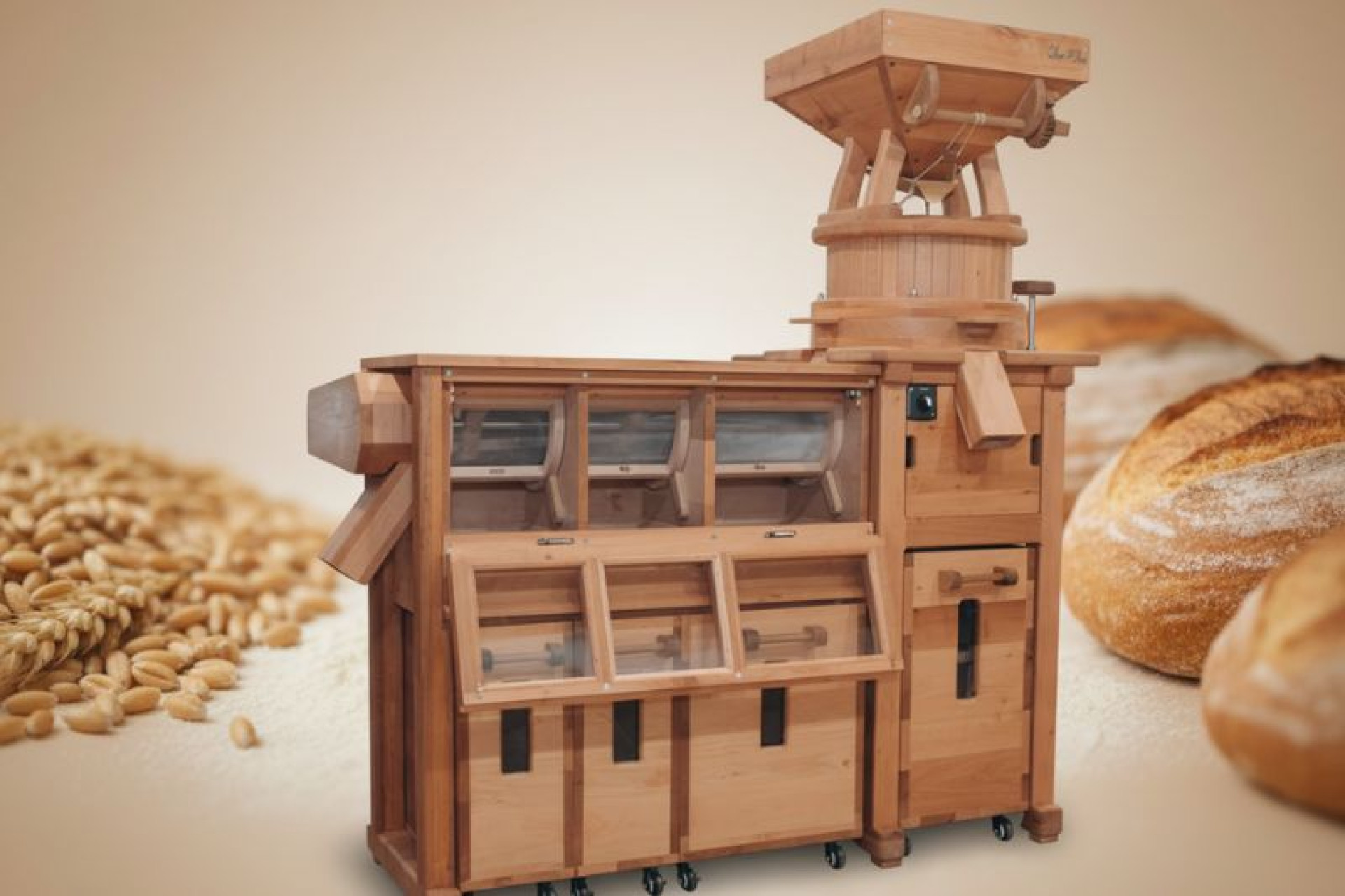
The Miller offers a wide range of stone grain mills for bakery production. The first step in selection is evaluating daily flour requirements.
For example:
Small to mid-size artisan bakery (≈ 450 loaves/day): D30S — up to 40 kg/hour capacity.
Larger production (≈ 900 loaves/day): D50S — up to 80 kg/hour capacity.
Both models include sifting systems with interchangeable sieve sets. The D50S can also be paired with an aspiration system to reduce flour dust in the workspace.
When installing bakery equipment, electrical requirements should also be considered. The D30S operates on a 230V single-phase supply with a frequency converter, while larger models require a 400V three-phase connection. All models can be wired for European or U.S. power standards.
To determine the most suitable stone mill for your bakery, you can request a consultation. The Miller team will help you select a tailored solution for your production needs.


