
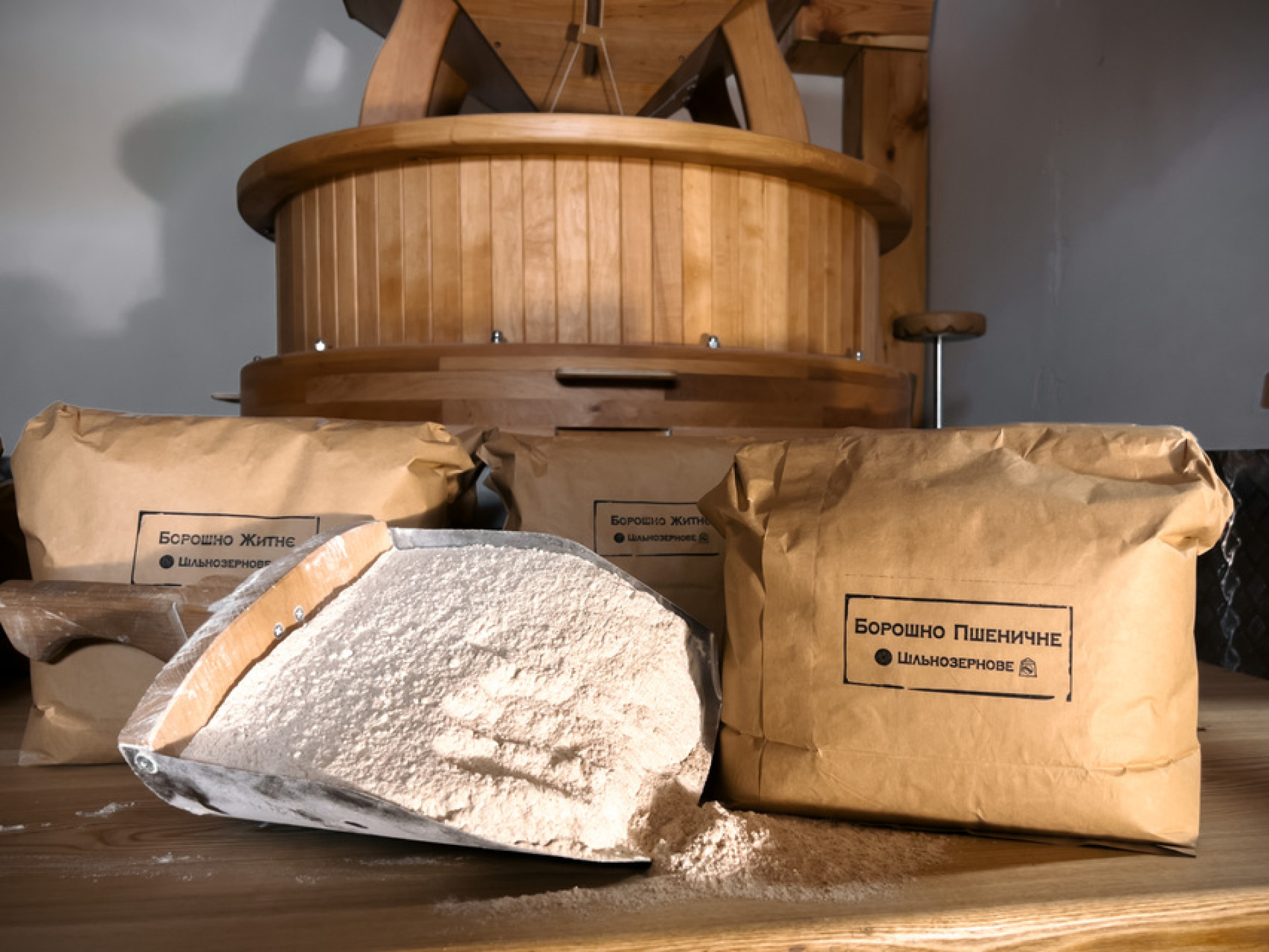
A stone mill is not a universal “grinder for everything.” In a production setting, it works as a precision tool: with the right raw materials it delivers consistent flour quality; with the wrong ones, it leads to process issues and production losses.
Stone milling relies on friction and pressure. That’s why the ideal raw material is dry, hard, and low in fat content.
This is the core category behind any flour business: wheat, rye, corn.
The Miller mills are designed to process all major wheat types — from traditional red and white wheat to spelt and ancient grains. This allows bakeries to develop their own flour lines with different flavor profiles, protein levels, and baking performance.
For example, Farmer Storehouse (Tennessee, USA) installed a D30S mini mill for a cooperative milling project, producing organic flour and supporting local farmers.
This is a premium and functional category:
After stone milling, these are used for gluten-free baking, functional breads, health-focused mixes, premium product lines, and artisan recipes.
The key advantage of stone milling here is the preservation of flavor, aroma, and nutritional value.
One of the fastest-growing segments:
They are used to produce high-protein flours, functional blends, and gluten-free products. At this point, it’s no longer just flour — it’s an ingredient for next-generation food products.
Stone mills can also handle certain non-traditional raw materials.
For example, for a Ukrainian health food store “Zdorovo,” we customized a D70S mill to produce coconut flour from dried raw material. This included a redesigned hopper, screw feeding system, and modified stone pattern.
Not all raw materials are suitable for stone milling. The wrong choice can lead to production losses and equipment issues.
High-oil products (e.g., sunflower seeds, flaxseed, sesame) tend to stick to the stones, disrupt the milling process, and reduce product quality and operational stability.
Moist raw materials. If moisture content exceeds ~14%, milling becomes uneven, the mill overheats, and the risk of downtime increases.
Aromatic and essential-oil-rich products (such as spices, herbs, coffee beans) can deeply penetrate the stone and contaminate subsequent batches with residual aroma and flavor.
With properly selected raw materials, a stone mill enables production of:
In practice, this is not a single product — but a full product line.
For example, Marea Bread bakery (Madrid, Spain), a multiple competition winner, launched a small wheat-growing project and installed a D30 mill to produce whole grain flour in-house.
The Miller mills are designed to process 15+ types of raw materials. For a business, this means:
A stone mill is a versatile tool — but its performance depends entirely on the raw material. It can either open new markets or create technical challenges.
In efficient production, technology and raw materials always work together — and that’s what ultimately defines the business outcome.
Talk to The Miller specialists to select the right mill configuration for your production needs.